
March 8, 2026 · 7 min read
SMA vs EMA: Moving Averages Explained for Algorithmic Traders
A visual, practical guide to the two most important moving averages in trading. Learn exactly how SMA and EMA differ, when each one wins, and how to combine them into real strategies you can backtest.
TL;DR
- SMA (Simple Moving Average) weights every price equally. It’s smooth, stable, and slow to react.
- EMA (Exponential Moving Average) weights recent prices more heavily. It’s faster, noisier, and catches reversals earlier.
- SMA is better for identifying the big trend. EMA is better for timing entries.
- The classic crossover strategy — fast MA crosses slow MA — works with both, but EMA crossovers trigger sooner (for better and worse).
- Neither is objectively better. The right choice depends on your timeframe, asset, and strategy type.
Moving averages are the first indicator most traders learn, and the last one many professionals stop using. They are everywhere: in trend filters, crossover systems, risk overlays, and regime classifiers. If you trade algorithmically, you will eventually need to decide between SMA and EMA — and that decision will affect your signal timing, false-positive rate, and backtest results.
This guide breaks down the math, the behavior, and the practical tradeoffs so you can make that choice deliberately.
What Is a Moving Average?
A moving average smooths out price data by averaging the last N closing prices. The result is a single line that trails behind the actual price, showing you the underlying direction without the noise.
Every moving average answers the same question: where has price been recently? The difference between types is how they define “recently.”
SMA: The Simple Moving Average
The SMA is a straight arithmetic mean. For a 20-period SMA, you add the last 20 closing prices and divide by 20.
SMAN = P1 + P2 + P3 + … + PN / N
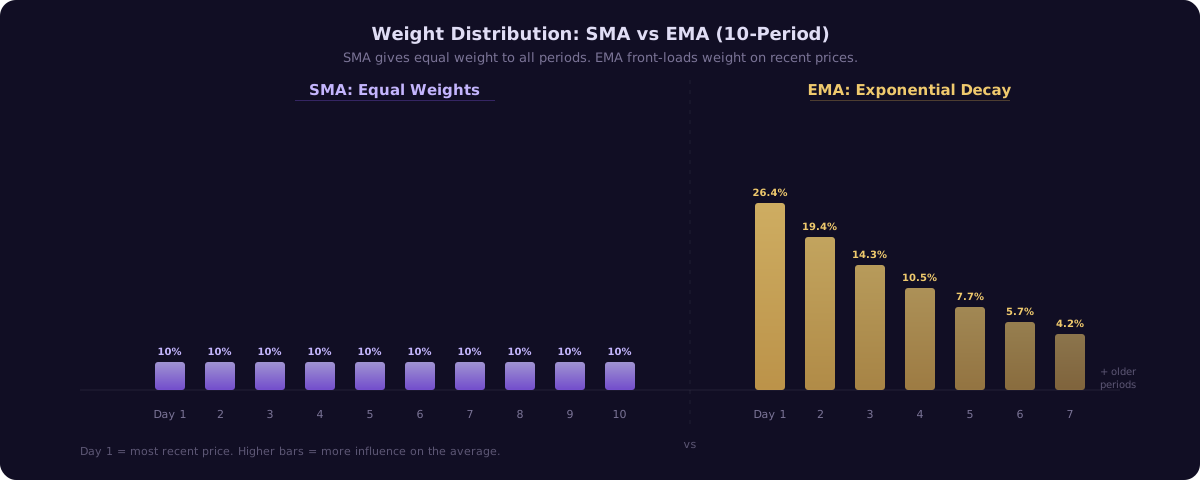
Every data point carries equal weight. The closing price from 20 days ago has the same influence as yesterday’s close. This is both the SMA’s strength and its limitation:
- Strength: It’s stable. A single spike or gap doesn’t jerk the line around.
- Limitation: It reacts slowly to real changes. When price reverses, the SMA keeps drifting in the old direction until enough new data accumulates.
The SMA is essentially a democratic vote across the lookback window — every day gets one vote, no matter how stale.
EMA: The Exponential Moving Average
The EMA applies a multiplier that gives more weight to recent prices and exponentially less weight to older ones. The formula is recursive:
EMAtoday = ( Price × k ) + ( EMAyesterday × (1 − k) )
where k = 2 / ( N + 1 )
For a 20-period EMA, k = 2 / 21 ≈ 0.095. That means today’s price gets about 9.5% of the total weight, yesterday’s EMA carries the rest — and because yesterday’s EMA already emphasized its most recent prices, the decay is exponential.
The effect: the EMA hugs price more tightly than the SMA.
How Lag Differs in Practice
Both moving averages lag behind price — that’s by design. But the amount of lag is where the practical difference shows up.
Consider a stock that rallies from $145 to $172 over four months, then pulls back. Watch what happens to each indicator:
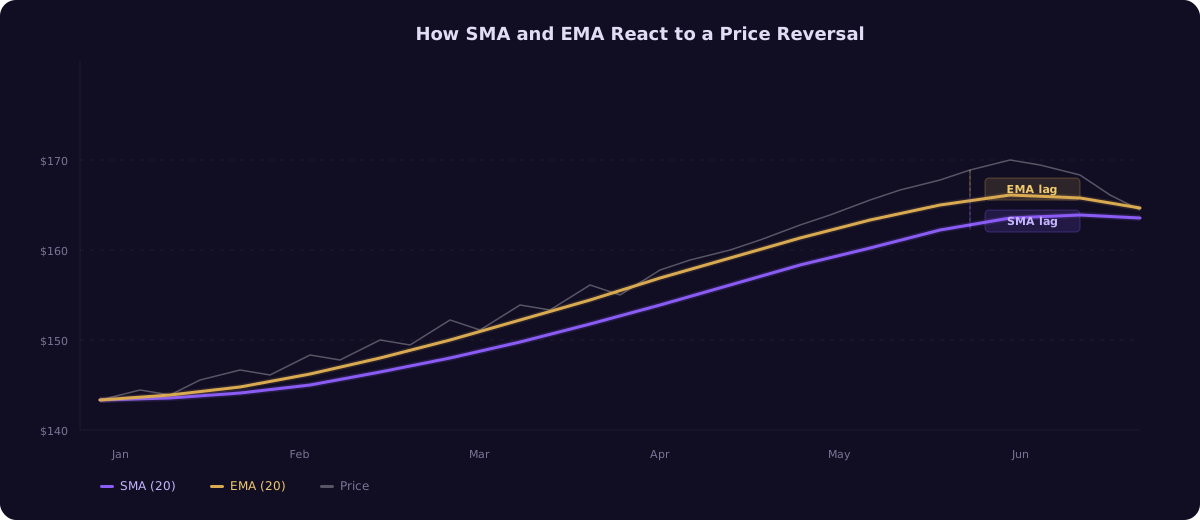
The EMA turns direction roughly 2–4 bars before the SMA does (depending on the period length and volatility). In a fast-moving market, those few bars are the difference between catching a reversal and riding it down.
But there’s a cost: the EMA also overreacts to noise. In choppy, sideways markets, the EMA whipsaws — crossing above and below price repeatedly — while the SMA stays flat and calm. More signals is not always better.
Side-by-Side Comparison
| Property | SMA | EMA |
|---|---|---|
| Weighting | Equal across all periods | Exponentially decaying |
| Lag | Higher — slow to react | Lower — tracks price faster |
| Noise sensitivity | Low — filters out spikes | Higher — reacts to every move |
| Best timeframe | Daily, weekly, monthly | Intraday, daily, swing |
| Common periods | 20, 50, 100, 200 | 9, 12, 21, 26, 50 |
| Classic use | Trend direction, support/resistance | Entry timing, crossovers |
| False signals in chop | Fewer | More |
| Computation | Trivial | Slightly more complex (recursive) |
Crossover Strategies: The Most Popular Application
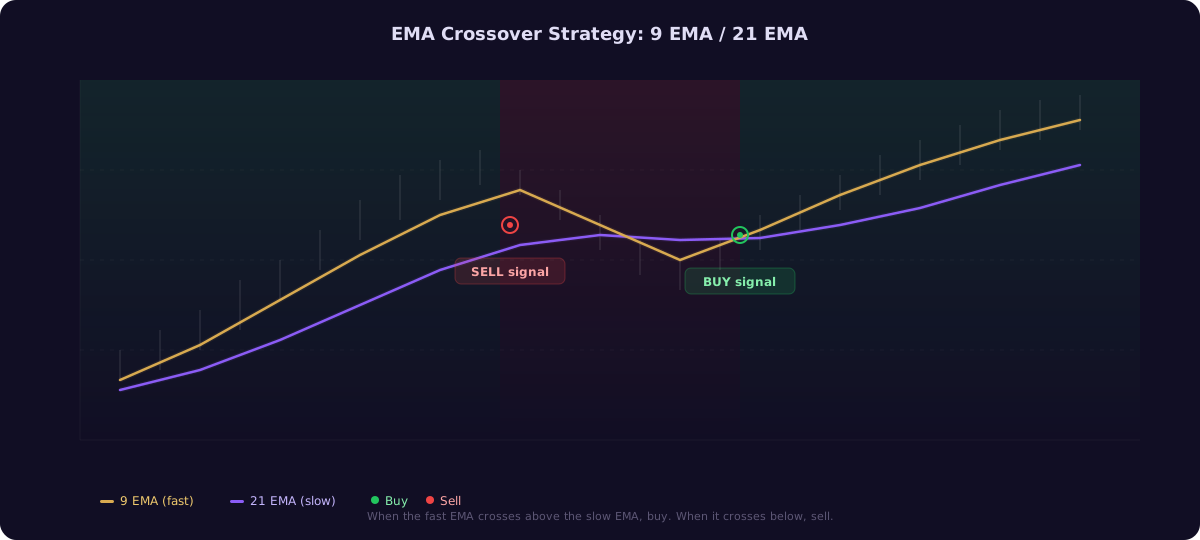
The crossover is the simplest moving-average strategy: use two MAs with different periods. When the fast MA crosses above the slow MA, buy. When it crosses below, sell.
The idea is straightforward — a short-term trend shift is happening, and the crossover confirms it.
SMA Crossovers
The 50/200 SMA crossover is the most famous in all of technical analysis. When the 50 SMA crosses above the 200 SMA, it’s called the Golden Cross — and Wall Street actually pays attention. The opposite is the Death Cross.
These work well for macro trend identification because the long lookback periods filter out most noise. The tradeoff: by the time a Golden Cross fires, the trend has been running for weeks or months. You’re trading confirmation, not prediction.
EMA Crossovers
EMA crossovers like the 9/21 EMA or 12/26 EMA (the backbone of MACD) fire faster. That earlier signal means better entries in trending markets — but more whipsaws in ranging ones.
Practical rule: EMA crossovers need a trend filter. Don’t trade the 9/21 crossover in both directions blindly. Pair it with a longer-term SMA (like the 200) to know the macro direction, then only take crossovers in that direction.
Crossover Logic
BUY when Fast MAtoday > Slow MAtoday and Fast MAyesterday ≤ Slow MAyesterday
SELL when Fast MAtoday < Slow MAtoday and Fast MAyesterday ≥ Slow MAyesterday
Choosing Between SMA and EMA
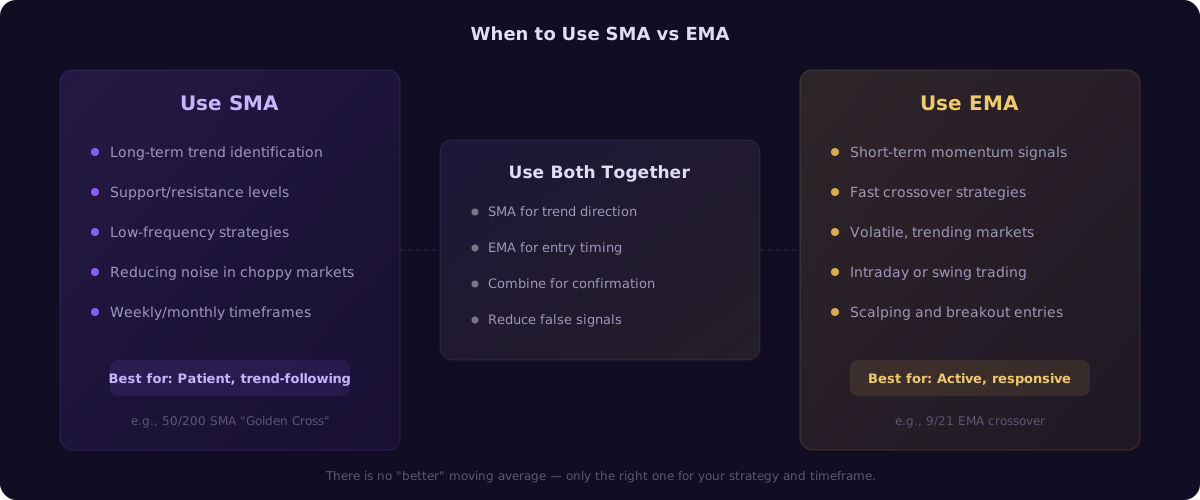
There is no universally “better” moving average. The right choice depends entirely on what you’re building.
Use SMA When:
- You’re building a trend filter (e.g., “only trade longs when price is above the 200 SMA”)
- You want support and resistance levels that the broader market watches
- Your strategy operates on weekly or monthly bars where noise is already low
- You want to minimize false signals in ranging markets
Use EMA When:
- You need fast entry signals — swing trades, intraday momentum
- You’re building a crossover system where speed matters
- The asset is trending strongly and you want your MA to stay close to price
- You’re computing MACD, which uses 12/26 EMAs by definition
Use Both Together:
The most robust approach is often a hybrid. Use an SMA for trend direction and an EMA for timing:
- 200 SMA — Is the long-term trend up or down?
- 9/21 EMA crossover — When does momentum shift within that trend?
- Only take EMA signals in the direction of the SMA trend.
This layered approach cuts out a significant number of false signals while keeping entries responsive.
Implementation Notes
If you’re building moving averages into an algorithmic system, a few practical details matter:
Warmup period. Both SMA and EMA need enough historical data before they produce meaningful values. An SMA(200) needs 200 bars of history. An EMA technically needs infinite history, but converges quickly — in practice, 3× the period length is sufficient.
Adjusted vs. unadjusted prices. Always compute moving averages on split-adjusted and dividend-adjusted close prices. Using raw closes will produce phantom crossovers on ex-dividend dates.
Tick data vs. bar data. Moving averages are defined on closing prices. Computing an SMA on every tick is meaningless — wait for bar closes.
Avoid overfitting the period. It’s tempting to optimize the exact lookback (is 19 better than 21?). Usually the answer doesn’t matter. If your strategy breaks when you change the period by ±2, it’s fragile and the edge is probably noise.
The Honest Truth About Moving Averages
Moving averages are lagging indicators. They don’t predict anything. They show you what has already happened, smoothed. Every signal they generate is late by definition.
This is not a weakness — it’s the design. The lag is the filter. The smoothing is the value. When you accept that a moving average will never catch the exact bottom or top, you stop chasing perfection and start building systems that work across many trades.
The edge in moving-average strategies is not in the indicator. It’s in position sizing, risk management, and discipline — the boring parts that actually compound.
Ready to test whether SMA or EMA works better for your strategy? ProvectusQuantus lets you describe crossover strategies in plain English, backtest them against real historical data, and see exactly how each moving average type performs — no code required.
References
- Moving Averages — Technical Analysis — Investopedia
- Exponential Smoothing for Time Series — Forecasting: Principles and Practice
- Alpaca Market Data API — Alpaca